The first thing my daughter noticed wasn’t the birthday cake.
It was the empty space where two chairs should have been.
“Dad,” Lily whispered, tugging on my sleeve. “Where do Noah and I sit?”
I looked around my mother’s dining room.
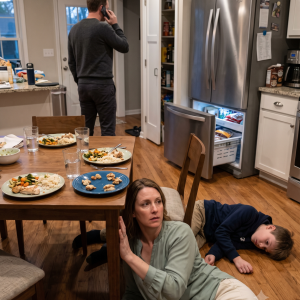
Seven white plates had already been set neatly on the oak table. Seven folded napkins. Seven wine glasses.
My parents.
My older sister Rachel.
Her husband.
Their teenage son.
My wife Claire.
Seven.
No eighth plate.
No ninth.
No chairs against the wall waiting to be pulled over.
No mistake.
My mother glanced up from arranging flowers in the middle of the table.
“Oh,” she said casually. “We’re full.”
For a second, nobody spoke.
Eight-year-old Noah shifted the small gift bag he had wrapped himself.
Lily tightened her grip on Claire’s hand.
My father kept cutting slices of roast beef as if he hadn’t heard a word.
Rachel reached for another dinner roll.
Only Claire looked at me.
She didn’t say anything.
She didn’t have to.
I had spent eleven years convincing myself my parents never meant to hurt anyone.
Standing in that dining room, staring at two children who had nowhere to sit, I couldn’t tell myself that anymore.
My Mother Called It “Just a Seating Problem”
“Mom,” I said quietly, “where are the kids supposed to eat?”
She looked genuinely puzzled that I had asked.
“They’re young.”
She shrugged.
“They can eat later in the kitchen.”
Lily lowered her eyes.
Noah looked toward the kitchen doorway before looking back at the table.
“But Grandma,” he asked carefully, “it’s your birthday.”
“I made you a card.”
He held it out with both hands.
My mother smiled without taking it.
“That’s sweet, honey.”
Then she turned back to Rachel.
“Could you pass the potatoes?”
It happened so naturally that nobody else seemed surprised.
As though my children being separated from the family table made perfect sense.
Claire knelt beside Lily.
“Sweetheart, are you okay?”
Lily nodded too quickly.
“It’s okay.”
Children say that when they know adults have already decided.
I looked around the room again.
There was enough space.
Someone could have brought over folding chairs from the garage.
Someone could have eaten at the kitchen island.
Someone could have waited.
Nobody moved.
Not one person.
This wasn’t the first strange thing.
It was simply the first one I couldn’t explain away.
For years my parents had insisted birthdays were “family only.”
Yet Rachel’s friends often appeared halfway through dinner.
My children rarely received invitations to sleep over.
Christmas stockings somehow never included their names unless Claire reminded everyone.
Whenever I mentioned it, my mother always had an explanation.
“We forgot.”
“The store ran out.”
“You’re reading too much into it.”
Eventually I stopped asking questions because every answer somehow became my fault.
Claire touched my arm.
“Ethan.”
Only my name.
Nothing else.
I knew exactly what she meant.
She wasn’t asking me to fight.
She was asking whether I was finally ready to stop pretending.
I looked at Noah.
He was still holding the birthday card.
No one had taken it.
I took a slow breath.
“Kids.”
Both of them looked up immediately.
“Let’s go.”
The room became quiet.
Rachel laughed once.
“Seriously?”
“You’re leaving over chairs?”
I picked up my car keys.
“No.”
I looked directly at my mother.
“We’re leaving because my children were invited to a family birthday and then told they weren’t part of the family dinner.”
My father finally spoke.
“Don’t be dramatic.”
My mother sighed loudly.
“You’re embarrassing everyone.”
Claire picked up our coats.
Neither child complained.
That hurt more than any argument could have.
They had accepted being unwanted before I had.
The Drive Home Was Quieter Than Any Argument
Nobody spoke during the first ten minutes.
Rain tapped softly against the windshield.
The birthday card rested on Noah’s lap.
Finally Lily asked the question I had been avoiding.
“Dad…”
“Did we do something wrong?”
I gripped the steering wheel harder.
“No.”
She waited.
“Then why didn’t Grandma want us there?”
Children deserve honest answers.
They don’t deserve adult excuses.
“I don’t know,” I admitted.
Claire reached back from the passenger seat and squeezed Lily’s hand.
No one cried.
That somehow made everything heavier.
After we tucked the kids into bed, Claire found me sitting alone on the back porch.
She handed me a mug of coffee.
Neither of us drank it.
“You’ve paid their mortgage for eleven years,” she said quietly.
I stared into the dark backyard.
“Almost every month.”
When my parents nearly lost their house after Dad retired, I’d promised to help.
At first it had been six months.
Then one year.
Then another.
Eventually it became automatic.
The money left my account on the first Friday of every month.
I never questioned it.
Every time I offered to pay the bank directly, Mom refused.
“It’s easier if you send it to us.”