The Widow They Never Expected to See Again
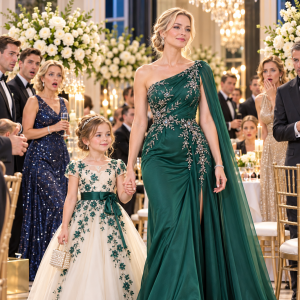
The charity ballroom inside the Fairmont Hotel in Boston glowed beneath hundreds of crystal lights.
Elegant guests moved between tables covered with white roses, polished silverware, and carefully placed name cards. Business leaders exchanged quiet greetings. Reporters waited near the stage. Members of the Evermont family stood at the entrance, welcoming investors as though the evening belonged entirely to them.
For years, their name had represented money, influence, and tradition across New England.
That night, however, the person who legally controlled their entire empire was standing outside the hotel.
And they had no idea she was coming.
A black sedan stopped beneath the entrance canopy.
When the driver opened the rear door, Celeste Evermont stepped onto the sidewalk wearing a sapphire-blue evening gown. Her dark hair was pinned neatly behind her shoulders, and a simple diamond necklace rested against her throat.
The necklace had once belonged to her late husband’s grandmother.
Six months earlier, her mother-in-law had told her she would never be worthy of wearing it.
Now Celeste walked through the hotel doors with her shoulders straight and her expression calm.
The first person to notice her was Dana Evermont, her husband’s younger sister.
Dana had been recording a video beside the flower wall when her smile suddenly disappeared.
Her phone lowered slowly.
Across the ballroom, Vivian Evermont followed her daughter’s frightened gaze.
The color faded from Vivian’s face.
Near the entrance, her husband, Harrison Evermont, stopped speaking in the middle of a conversation with two investors.
Celeste continued walking.
She did not hurry.
She did not look around nervously.
She moved through the room like someone who no longer needed permission to belong there.
The Day They Threw Her Away
Six months earlier, Celeste had stood beneath the covered entrance of the Evermont estate in Rye, New York, while cold rain soaked through her black funeral dress.
Her husband, Nolan Evermont, had been laid to rest only the day before.
He had been thirty-four years old.
One week earlier, he had been sitting across from Celeste in their kitchen, teasing her for making too much coffee and promising they would finally take a vacation when his work schedule became less demanding.
Then an unexpected medical emergency changed everything.
The house that had once been filled with his voice became unbearably quiet.
Celeste had barely slept after the funeral. She had spent the night holding Nolan’s sweater against her chest, breathing in the faint traces of his cologne and wondering how the world could continue moving when hers had stopped.
The next morning, Vivian entered the guest room without knocking.
She carried a legal folder beneath one arm.
“You need to leave before noon.”
Celeste stared at her.
“Nolan has been gone for one day.”
Vivian’s expression remained cold.
“And this house belongs to the Evermont family. Your place here ended when my son’s life ended.”
Celeste could hardly understand what she was hearing.
She had lived in that home for nearly four years. She had cared for Nolan through exhausting workweeks, attended family events, hosted dinners, and remained silent whenever Vivian introduced her as “the nurse Nolan married.”
Celeste had never been good enough for them.
She had come from a modest family in Albany. Her father repaired heating systems, and her mother worked in a public library. Celeste had earned her nursing degree through scholarships and weekend shifts.
To Vivian, that background had always been something shameful.
By late morning, two household employees had carried Celeste’s belongings onto the front steps.
Dana stood near the doorway holding her phone.
“Make sure you get the whole thing,” Vivian told her daughter.
Dana smiled as she recorded.
“People will finally understand that marrying into this family doesn’t make someone one of us.”
Vivian dragged a faded suitcase toward the steps and pushed it forward.
The suitcase opened when it struck the wet ground.
Celeste’s sweaters, shoes, nursing uniforms, and framed photographs scattered across the muddy grass.
A small wooden box Nolan had made for her landed beside the driveway.
Then their wedding album slipped from the suitcase and fell open in a shallow puddle.
Celeste stared at the photograph on the page.
Nolan was laughing beneath an arch of autumn leaves, his forehead resting against hers.
Something inside her nearly broke.
She walked into the rain and lifted the album carefully.
Vivian remained beneath the dry entrance.
“You signed a marriage agreement,” she said. “You leave with whatever you brought into this family, which was very little.”
Celeste wiped rainwater from Nolan’s photograph.
Then she looked at the woman who had waited until her weakest moment to remove her from the home.
“You are right about one thing,” Celeste said quietly. “I am leaving.”
Dana laughed behind the camera.
Neither woman noticed the sealed envelope inside Celeste’s handbag.
Neither woman knew Nolan had placed it there three weeks before his passing.
Nolan’s Final Decision
Celeste did not return to her old apartment in Albany as the Evermont family expected.
Instead, she traveled to a quiet law office in downtown Boston.
Nolan’s personal attorney, Everett Sloan, was waiting for her in a private conference room.
He offered her tea, but Celeste could not stop her hands from trembling long enough to hold the cup.
Everett placed several documents on the table.
“Your husband came here three weeks before the emergency,” he explained. “He was concerned about the company and about what his family might do if something happened to him.”
Celeste looked down at Nolan’s signature.
“He never told me.”
“He wanted the transfer completed before discussing it with you. He believed you might refuse because you would think accepting it meant taking something away from his family.”
That sounded exactly like Nolan.
Celeste had never wanted the Evermont fortune. She had continued working as a pediatric nurse even after their marriage because helping children gave meaning to her life.
Everett turned to another page.
Nolan had inherited fifty-four percent of Evermont Maritime Holdings from his grandfather. The controlling shares had never belonged to Harrison, even though Harrison served as the company’s chief executive and behaved as though he owned everything.
Nolan had transferred those shares to Celeste.
He had also given her full voting authority, ownership of several company-controlled properties, and the power to restructure the board.
Celeste stared at the documents.
“Why would he place all of this in my hands?”
Everett’s answer was gentle.
“Because he trusted your character more than he trusted their ambition.”
Nolan had also left a private letter.
Celeste opened it alone that evening.
He wrote that his father had been using company accounts to finance personal trips, luxury renovations, private vehicles, and questionable business arrangements. Dana had been charging extravagant purchases to a corporate entertainment account. Vivian had treated the family foundation as her personal social platform.
Nolan feared the company his grandfather built would collapse if no one intervened.
His final words to Celeste were simple.
“Protect the employees. Protect the company. And never let my family convince you that kindness makes you powerless.”
Celeste read the letter until sunrise.
Then she began preparing.
Six Months of Silence
The Evermont family interpreted Celeste’s disappearance as defeat.
They told friends she had returned to an ordinary nursing job.
Dana posted a vague message about “people who marry for status and leave with nothing.”
Vivian replaced Celeste’s photographs inside the estate within a week.
Harrison continued running the company without realizing that every major decision now required the approval of a woman he had dismissed as irrelevant.
Celeste remained silent.
Every Tuesday, she met Everett and a team of financial specialists in Boston.
At first, the documents felt overwhelming. Shipping schedules, international contracts, insurance reports, debt obligations, board minutes, executive expenses, and property records covered the conference table.
Celeste approached them the same way she approached a complicated hospital case.
She remained calm.
She asked careful questions.
She looked for patterns.
Within two months, she understood more about the company’s financial condition than several longtime executives.
She discovered inflated consulting contracts connected to Harrison’s friends. She found private vacations described as executive retreats. She learned that Vivian’s charitable events cost almost as much as they raised.
Dana had even used company funds to renovate a luxury apartment in Manhattan.
The company was not beyond saving, but it was moving toward serious trouble.
Celeste could have acted immediately.
Instead, she waited until she had complete documentation, reliable advisers, and enough board support to make every decision impossible to reverse.
Silence became her strategy.
Grief became her discipline.
By the time the Evermont Foundation announced its annual gala, Celeste was ready.
The Question That Changed the Ballroom
Vivian reached Celeste near the center of the ballroom.
Her eyes moved over the blue gown and the family necklace.
“Where did you get that?”
Celeste looked at her calmly.
“Good evening, Vivian.”
“That necklace belongs to my family.”
“It belonged to Nolan’s grandmother. Nolan legally placed it in my possession.”
Dana hurried toward them.
“You cannot just walk in here wearing our jewelry.”
Celeste glanced at Dana’s phone.
“Are you recording again?”
Dana quickly lowered it.
Harrison arrived moments later.
He forced a polite smile because several guests were already watching.
“Celeste, this is a private foundation event. You were not invited.”
“That is an interesting thing to say to the chairwoman of the foundation.”
Harrison’s smile vanished.
“What are you talking about?”
Everett Sloan appeared beside Celeste carrying a leather portfolio.
He handed Harrison a formal notice.
“Mr. Evermont, the board held an emergency meeting this afternoon,” Everett said. “Mrs. Evermont attended as the controlling shareholder of Evermont Maritime Holdings.”
Harrison looked from the document to Celeste.
“Controlling shareholder?”
Nearby conversations faded.
Several investors stepped closer.
Everett continued.
“Nolan Evermont legally transferred his fifty-four-percent ownership interest, voting authority, and executive rights to his wife before his passing.”
Vivian shook her head.
“That cannot be true. She signed an agreement before the wedding.”
“The agreement covered property owned before the marriage,” Everett explained. “It did not prevent Nolan from transferring assets he legally controlled.”
Dana looked genuinely frightened now.
“Dad, tell them this is fake.”
Harrison flipped through the pages.
His hands were no longer steady.
“Nolan would never do this.”
Celeste finally answered.
“Nolan knew exactly what he was doing.”
The Truth Nolan Had Uncovered
Celeste walked toward the stage.
A reporter moved aside as she approached the podium.
The musicians stopped playing.
Every face in the ballroom turned toward her.
Celeste placed both hands beside the microphone.
For one brief moment, she imagined Nolan standing at the back of the room, offering the quiet smile he always gave her when he knew she was afraid but believed she could continue.
She began speaking.
“My husband cared deeply about this company because thousands of employees and their families depended on it.”
Harrison stepped toward the stage.
“Celeste, this is not the place.”
She looked directly at him.
“This became the place when your family chose to build its reputation inside this ballroom.”
Whispers moved through the crowd.
Celeste continued.
“Over the past six months, independent specialists have reviewed company expenses, contracts, executive accounts, and foundation records.”
A screen behind her came to life.
Financial summaries appeared.
There were no private or overly sensitive details, only clear totals and documented categories.
Personal travel.
Luxury renovations.
Unapproved vehicles.
Questionable consulting agreements.
Excessive entertainment spending.
Several board members turned toward Harrison.
Celeste’s voice remained steady.
“The business Nolan’s grandfather created was being treated like a private source of unlimited money. That ends tonight.”
Harrison climbed onto the first stage step.
“You have no experience running an international company.”
Celeste did not raise her voice.
“I have experience recognizing danger before it becomes impossible to repair. I have experience making difficult decisions while frightened people depend on me. Most importantly, I know the difference between responsibility and entitlement.”
The room became completely still.
“Effective this afternoon, Harrison Evermont has been removed as chief executive officer pending a complete review. Three board members connected to unapproved financial activity have also been suspended.”
Harrison’s face turned pale.
“You cannot remove me from my own company.”
Celeste held his gaze.
“It was never yours to use however you pleased.”
When Vivian Asked for Mercy
Vivian rushed toward the stage.
The confidence she had displayed at the estate was gone.
“Celeste, please do not do this publicly.”
Celeste looked down at her.
“You did not worry about privacy when Dana recorded me standing in the rain.”
Vivian’s eyes filled with tears.
“I was grieving. I did not know what I was doing.”
“You knew exactly what you were doing. You waited until I had buried my husband, then you decided I was too weak to resist you.”
“We are still family.”
Celeste’s expression softened, but her decision did not.
“Family does not measure a person’s value by her bank account. Family does not throw photographs into the mud. Family does not use grief as an opportunity to humiliate someone.”
Dana began crying beside her mother.
“You are taking everything from us.”
Celeste turned toward her.
“I am taking nothing that belonged to you. I am simply ending your access to things you treated as though they had no limits.”
She signaled toward the hotel’s security director.
Four security employees approached quietly.
“Please escort Harrison, Vivian, and Dana from the ballroom,” Celeste said. “They are no longer authorized to represent the company or the foundation.”
Harrison’s anger finally broke through his polished appearance.
“My family built this business!”
Celeste looked at him one last time.
“Nolan’s grandfather built it. Nolan tried to save it. I intend to finish what he began.”
As security guided them toward the doors, Celeste lifted the microphone again.
“There is one additional matter.”
Vivian stopped walking.
“The Rye estate is owned by Evermont Maritime Holdings and has been maintained through company funds. Its use as a private family residence has been terminated.”
Vivian turned slowly.
Celeste’s voice remained calm.
“You have forty-eight hours to collect your personal belongings. After that, anything remaining will be packed and placed outside for collection.”
Dana stared at her.
Harrison said nothing.
Celeste held Vivian’s gaze.
“I trust you remember how suitcases are handled when someone is no longer welcome.”
What Celeste Chose to Build
After the doors closed, Celeste remained at the podium.
She did not feel victorious.
She felt tired, relieved, and deeply aware of the empty space where Nolan should have been.
She turned toward the employees, investors, donors, and reporters.
“Tonight is not about replacing one powerful family member with another. It is about returning this company to the values it claims to represent.”
She announced new financial controls, employee representation on the advisory council, an independent ethics committee, and a commitment to use foundation funds for community programs rather than expensive social displays.
For several seconds, no one moved.
Then an older board member stood and began clapping.
Others joined him.
The applause grew until it filled the ballroom.
Celeste closed her eyes briefly.
She did not hear celebration.
She heard Nolan’s words.
Protect the employees.
Protect the company.
Never confuse kindness with weakness.
The Life She Created Afterward
Four months later, Celeste stood inside the company’s renovated executive office overlooking Boston Harbor.
The financial review had recovered millions in misused funds. Several contracts had been canceled. New leadership had stabilized the company, and employee confidence was slowly returning.
Celeste had also changed the foundation’s priorities.
Part of the annual gala budget was redirected toward pediatric care, emergency housing for widowed parents, and educational grants for children of company employees.
She continued working one day each week at the children’s hospital.
People often asked why the majority owner of a major company still wore nursing shoes and walked through pediatric hallways.
Her answer never changed.
“Because power should never make you forget who you were before people started treating you as important.”
One evening, Celeste returned to the Rye estate for the first time since the rainy morning she had been removed.
The house was empty.
She walked through the silent rooms until she reached the kitchen where Nolan used to make coffee.
On the table, she placed their restored wedding album.
A specialist had carefully cleaned every damaged page.
Celeste opened it to the photograph that had once fallen into the mud.
Nolan was smiling beneath the autumn leaves.
She touched his wedding band, which she still wore beside her own.
“They thought you left me with nothing,” she whispered. “But you left me your trust, and that was worth more than everything they tried to keep.”
Rain began tapping softly against the windows.
This time, Celeste was standing inside.
She was not the frightened widow who had walked down the driveway with wet shoes and a damaged photograph.
She was a woman who had learned that grief could exist beside courage, that gentleness could stand beside authority, and that silence could become powerful when it was guided by patience.
The Evermont family had believed they were ending her story.
They had only given her a reason to begin a stronger one.
Never assume that a quiet person has accepted defeat, because silence may simply be the place where courage, knowledge, and a careful plan are growing together.
The way people treat you when they believe you have no money, influence, or protection reveals the truth of their character more clearly than years of polite behavior.
Grief can leave a person feeling empty, yet the love behind that grief can also become the reason they rise and protect what still matters.
True strength does not always enter a room loudly; sometimes it arrives with steady steps, clear evidence, and no need to demand attention.
When someone humiliates you during your weakest moment, they are not proving that you are small; they are revealing how little compassion exists inside them.
Kindness should never be confused with helplessness, because the gentlest person in the room may also be the one brave enough to make the hardest decision.
You do not need to answer every insult immediately, since patience often gives the truth enough time to become stronger than anger could ever be.
The most meaningful legacy is not measured by houses, jewelry, or company titles, but by the trust we leave in the hands of someone whose heart we truly understand.
Walking away from cruelty does not mean you have lost; sometimes distance is what allows you to prepare, heal, and return with your dignity protected.
The greatest victory is not making others feel the pain they caused you, but becoming strong enough to protect your future without losing the humanity that made you worthy of trust.