The Biker Who Learned to Knit for the Smallest Babies
A Man Everyone Misjudged
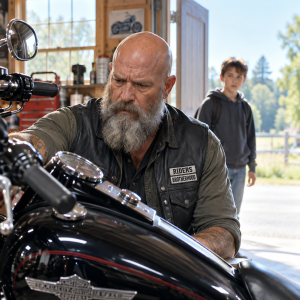
At fifty-seven years old, Wade Hensley looked like the last person anyone would expect to find holding a pair of knitting needles.
He stood six feet four inches tall, weighed close to three hundred pounds, and had broad shoulders shaped by decades of repairing motorcycles. His gray beard covered most of his weathered face, and faded designs stretched across both forearms. He usually wore heavy boots, worn jeans, and a dark leather vest decorated with patches from the motorcycle group he had ridden with for more than twenty years.
Wade owned Hensley Custom Cycles, a small repair shop outside Knoxville, Tennessee. Most days, the building smelled of engine oil, fresh coffee, leather, and metal warmed by the afternoon sun.
People who met him for the first time often stepped aside.
Children sometimes stared at him in grocery stores. Strangers lowered their voices when he entered a quiet room. Even grown men occasionally avoided meeting his eyes.
Wade understood why.
He looked serious even when he was relaxed, and his voice sounded like gravel under heavy tires. But the people who knew him well understood that beneath the intimidating appearance was a patient man who remembered birthdays, carried groceries for elderly neighbors, and never allowed anyone to leave his garage with an unsafe motorcycle.
His younger brother, Curtis, often joked that Wade had the appearance of a storm cloud and the heart of a porch light.
Wade always pretended to dislike the comparison.
“A porch light does not own four motorcycles,” he would reply.
Curtis would laugh and say, “That is not the point.”
Everything changed when Wade’s niece, Maribel, gave birth several weeks earlier than expected.
The Call That Changed Everything
Maribel had always been more like a daughter to Wade than a niece.
Her father had spent years traveling for work, and Wade had quietly filled the empty spaces. He taught her how to ride a bicycle, attended her school concerts, and showed up for every important event without waiting to be invited.
When Maribel entered the hospital unexpectedly, Wade was repairing a touring bike in his garage. His phone rang three times before he heard it above the tools and music.
Curtis was on the other end.
His voice was unsteady.
“The baby came early. They moved her into the newborn intensive care unit.”
Wade stopped working.
“Is she all right?”
“The doctors are helping her. She is very small, Wade.”
He wiped his hands on an old cloth and left the garage without turning off the lights.
At the hospital, Wade felt completely out of place. The hallways were bright, quiet, and polished. Nurses moved quickly between rooms, while families sat together speaking in whispers.
Through a large window, Wade saw his grandniece for the first time.
Her name was Ivy.
She rested inside a clear incubator, surrounded by small monitors and carefully arranged blankets. A tiny cap covered her head, though even the smallest hospital hat appeared loose around her.
Wade stared through the glass for a long time.
He had spent most of his life fixing damaged machines. Machines made sense. If something stopped working, he could inspect it, replace the broken part, and test it again.
But he could not repair this situation with a wrench.
He could only stand there and watch.
A nurse named Taryn Bell approached him gently.
“She is receiving excellent care,” she said. “She is stronger than she looks.”
Wade kept his eyes on Ivy.
“She looks like she could fit inside one of my gloves.”
Taryn smiled softly.
“Many babies here are much smaller than their families expected. That is why everything we use has to be carefully sized.”
Wade noticed several tiny knitted hats stacked in a basket near the nurses’ desk.
Some were pale yellow, others soft blue or green. Each one appeared small enough to fit over the top of a coffee cup.
“Where do those come from?” he asked.
“Volunteers make them,” Taryn explained. “The hospital can always use more.”
Wade looked at the basket again.
Something inside him shifted.
“How hard can it be to make one?”
Taryn glanced at his enormous hands before carefully hiding a smile.
“It takes patience.”
Wade nodded once.
“I have rebuilt engines that arrived in boxes. I can learn patience.”
His First Pair of Needles

The following morning, Wade drove to a craft store in Maryville.
He remained in the parking lot for almost ten minutes before going inside.
The store was filled with bright fabric, decorative flowers, ribbons, paint, beads, and shelves containing more kinds of yarn than Wade had known existed.
He walked slowly through the aisles, looking increasingly confused.
A store employee named Corinne approached him.
She was in her early sixties and wore glasses attached to a colorful chain.
“Can I help you find something?”
Wade cleared his throat.
“I need yarn for a baby hat.”
Corinne looked at his leather vest and large boots, then at his hands.
“Are you buying a finished hat or making one?”
“Making one.”
She smiled.
“Do you already know how to knit?”
“Not yet.”
Corinne spent nearly forty minutes helping him choose soft hospital-approved yarn, simple needles, and a beginner’s instruction book.
Before he left, she wrote the name of a local community knitting group on the back of his receipt.
“They meet every Wednesday evening,” she said. “They welcome beginners.”
Wade placed the receipt in his wallet.
“I am not really a group person.”
“Neither are half the people in the group,” Corinne replied. “That is why they focus on the yarn.”
That evening, Wade sat alone in his garage beside a partially restored motorcycle and opened the instruction book.
His first attempt lasted less than six minutes.
The yarn tangled around his fingers. One needle slipped under a workbench. The other nearly landed in a cup of coffee.
When Curtis entered the garage, he found Wade staring at a knot the size of a golf ball.
Curtis stopped in the doorway.
“I am going to need an explanation.”
Wade did not look up.
“Maribel’s baby needs hats.”
“And you are making them?”
Wade pointed a needle in his direction.
“Keep talking, and I am making you a scarf.”
Curtis wisely walked away.
Learning to Work Slowly
For the next several nights, Wade practiced after closing the repair shop.
He watched instructional videos, studied diagrams, and repeatedly pulled apart rows that did not look right.
His first piece of knitting was too wide to be a baby hat and too short to be anything useful.
The second had a large opening near the top.
The third leaned strangely to one side.
Wade called it “experimental” and placed it in a drawer.
By the tenth attempt, he could create something recognizable. By the twentieth, his stitches became more even. By the fiftieth, he had developed a steady rhythm.
Needle, loop, pull, breathe.
Again.
He discovered that knitting was not easier than motorcycle repair. It required a different kind of attention.
Machines responded to pressure and precision. Yarn responded to patience.
When Wade became frustrated, his hands tightened and the stitches became too small. When he rushed, the rows became uneven. He had to relax his shoulders, slow his breathing, and allow the pattern to form one movement at a time.
Eventually, he remembered Corinne’s note about the community group.
On a rainy Wednesday evening, he walked into the Blount County Community Center carrying a bag of yarn.
The room became silent.
Seven women sat around a long table covered with baskets, needles, tea cups, and half-finished blankets.
Their group leader, Lenora Webb, stood to greet him.
She was small, silver-haired, and completely unimpressed by Wade’s size.
“You must be here to learn,” she said.
“I was told you could help.”
“Sit down, then. Looking nervous will not improve your stitches.”
Wade took a folding chair that appeared much too small for him.
Lenora inspected his work.
“Your tension is uneven.”
“My niece said the same thing about my personality.”
One of the women laughed.
The uncomfortable silence disappeared.
Lenora showed him how to hold the yarn without pulling too tightly. Another woman demonstrated how to correct a dropped stitch. By the end of the evening, Wade had completed three neat rows.
It was not much, but he carried the small piece home as if it were important.
Because to him, it was.
The Garage Full of Softness
Wade initially hid the yarn inside an old metal toolbox at the back of the garage.
He worried that customers would make jokes. His repair shop had always been a place of engines, steel parts, and loud conversations. Bright balls of soft yarn seemed to belong to another world.
But Wade soon grew tired of hiding them.
He cleared an entire shelf and organized the yarn by color. Pale blue sat beside cream, followed by soft green, lavender, and yellow. Small labels reminded him which materials had been approved by the hospital.
The first customer to notice was a retired firefighter named Hollis Crane.
Hollis stared at the shelf for several seconds.
“Is that yarn?”
Wade continued cleaning a motorcycle part.
“It is.”
“Are you decorating the garage?”
“I make hats for babies who arrive early.”
Hollis nodded slowly.
“That makes more sense than decorating.”
The nickname began that afternoon.
Hollis called him Stitch.
Wade objected immediately.
The name remained.
Soon, members of Wade’s motorcycle group began visiting the garage with bags of yarn. They did not always understand which type was suitable, so Lenora wrote a list for Wade to tape near the entrance.
One rider arrived with rough outdoor yarn intended for winter socks.
Wade held it up and frowned.
“This could polish a truck tire.”
The rider shrugged.
“It looked soft in the picture.”
Another man brought six balls of bright orange yarn.
A third quietly left a gift card on Wade’s desk without saying anything.
The teasing continued, but it was gentle. More importantly, the donations kept arriving.
A broad-shouldered rider named Jefferson “Rook” Dillard was the first to ask Wade for a lesson.
Rook placed his large hands on the workbench and looked uncomfortable.
“My granddaughter spent three weeks in one of those hospital units,” he said. “Her mother still keeps the little hat they gave her.”
Wade handed him a pair of needles.
“Then sit down.”
Rook looked at the needles as though they were complicated tools.
“Do not tell the others.”
Wade smiled.
“They will know when you start bringing yarn to meetings.”
When the Riders Joined In
Within two months, six riders were learning to knit.
They met every Thursday evening after the garage closed. Wade placed folding chairs in a rough circle, and Lenora visited twice a month to correct their mistakes.
The sight would have surprised anyone passing the open doors.
Men known for long road trips and loud motorcycles sat beneath fluorescent lights, concentrating on tiny loops of yarn. Some wore reading glasses. Others held instruction sheets inches from their faces.
They argued about colors, complained about difficult patterns, and celebrated whenever someone finished a hat without dropping a stitch.
Rook preferred blue and gray.
Hollis liked stripes.
A quiet rider named Darnell Vickers became unexpectedly skilled at making tiny blankets.
Wade remained focused on hats.
“One useful thing done well is better than ten unfinished ideas,” he often said.
The group began keeping count on a whiteboard.
Ten hats became twenty.
Twenty became fifty.
At one hundred, Wade made a pale-yellow hat that reminded him of Ivy’s first morning in the hospital.
The stitches were nearly perfect.
He held it carefully in both hands.
For a moment, the noise of the garage seemed to fade. He remembered seeing Ivy through the glass, so small and fragile that he had been afraid even to breathe too close to the window.
He also remembered the nurses moving around her with calm confidence.
They had performed a thousand careful tasks that the family never fully understood. They adjusted blankets, checked monitors, comforted nervous parents, and protected small lives through long nights.
Wade folded the yellow hat and placed it in a clean bag.
On the front, he wrote the number 100.
Then he sat alone in the garage and allowed himself to cry.
The Delivery to the Hospital
When the riders completed two hundred hats, Lenora helped Wade contact the hospital.
A few days later, he arrived at the newborn unit carrying two large sealed containers. Taryn recognized him immediately, though several months had passed since Ivy’s stay.
“You came back,” she said.
Wade set the containers on a table.
“That was the plan.”
Taryn opened the first container and stared at the rows of carefully folded hats.
Every hat had been washed according to hospital instructions, sealed separately, and labeled by approximate size.
“You made all of these?”
“Not alone. The knitting group helped. Some riders helped too.”
Taryn lifted a lavender hat and ran one finger carefully across the stitches.
“Do you understand what these will mean to the families?”
Wade looked toward the nearby windows.
“They are only hats.”
Taryn shook her head.
“No. They are proof that someone outside these walls thought about their children.”
The hospital arranged a small gathering in the family waiting room. Several nurses joined them, along with Maribel and Ivy, who had grown stronger and healthier.
Ivy slept peacefully against her mother’s shoulder.
Maribel looked at the hats and then at her uncle.
“You did all this because of her?”
Wade’s voice softened.
“She started it.”
Maribel began crying, though she was smiling.
“I do not know what to say.”
Wade reached out and gently touched one of Ivy’s tiny socks.
“You do not have to say anything. Just keep bringing her to the garage when she is older.”
“Why?”
“Someone has to teach her how to change the oil.”
The nurses laughed.
Even Wade smiled.
The Hat That Returned
Several weeks later, an envelope arrived at the garage.
There was no return address.
Inside, Wade found a photograph of a tiny baby resting in an incubator. The child wore a pale-green hat with a silver stripe near the bottom.
Wade recognized it immediately.
He had made that hat.
A handwritten note was attached to the photograph.
The parents explained that their son had arrived much earlier than expected and weighed only a little over two pounds. They had felt frightened, exhausted, and powerless.
Then a nurse placed Wade’s green hat over their baby’s head.
It was the first item that seemed to belong only to him.
The note said they kept the hat after leaving the hospital and planned to place it in a memory box with his first photographs.
The final sentence made Wade sit down.
“Thank you for reminding us that our son was already loved by people who had never met him.”
Curtis found him several minutes later, still holding the photograph.
“Are you all right?”
Wade shook his head.
“Not really.”
Curtis sat beside him without asking another question.
After a while, Wade handed him the note.
Curtis read it slowly.
Neither man spoke for several minutes.
Wade had once believed the hats were simply useful objects. He thought they kept small heads warm and gave nurses something practical to offer families.
But the photograph taught him that each hat carried something else.
It carried reassurance.
It told parents that their child mattered beyond the hospital room. It gave them something soft to hold during a time filled with uncertainty. It became part of a family’s first memories.
Wade placed the photograph above his workbench.
Then he picked up his needles and began another hat.
A Tradition Built One Stitch at a Time
Wade never stopped knitting.
He did not make two hundred hats every month, and he did not turn the project into a large organization. He continued repairing motorcycles, attending community meetings, and visiting Ivy whenever Maribel brought her to town.
But every week, he completed a few more hats.
The riders created an annual donation event called Warm Miles. Local families contributed yarn, craft stores offered discounts, and volunteers helped wash, label, and package the finished items.
Wade refused to stand on a stage or make speeches.
Whenever someone praised him, he redirected the attention toward the nurses, volunteers, and families.
“These babies cannot be rushed,” he often said. “Their parents cannot be rushed either. We are only making something small enough to be useful while they wait.”
Years later, Ivy began visiting the garage after school.
She sat on a stool beside Wade, holding a short pair of needles while he patiently guided her hands.
“The yarn keeps slipping,” she complained.
“That means you are learning.”
“Did you make my first hat?”
Wade looked at her and smiled.
“No. Someone else made yours.”
Ivy considered that.
“So you make hats because someone made one for me?”
“That is part of it.”
“What is the other part?”
Wade helped her pull the yarn through another loop.
“Kindness should keep moving.”
Ivy looked down at the uneven row she had created.
“Even when it looks messy?”
“Especially then.”
True strength is not measured by how intimidating a person appears, but by how gently that person chooses to care for someone who may never be able to offer anything in return.
A small act of kindness may seem ordinary to the person giving it, yet it can become one of the most meaningful memories carried by a family during an uncertain season.
We should never assume that someone’s appearance reveals the limits of their compassion, because the most tender hearts are sometimes hidden behind rough voices, worn clothes, and guarded expressions.
Learning something new is not embarrassing, even when our first attempts are awkward, because humility allows us to become useful in ways pride would never permit.
Patience is a form of love, especially when it asks us to slow down, repeat the same careful movement, and continue even when no one is watching or applauding.
Gratitude becomes more powerful when it is transformed into action, because saying thank you is meaningful, but helping another family feel less alone allows kindness to continue far beyond one moment.
No gift is too small when it is offered with sincere care, because even a tiny hat can remind exhausted parents that their child is seen, valued, and surrounded by hope.
Communities grow stronger when people bring different skills, backgrounds, and personalities together for a shared purpose instead of deciding that compassion belongs only to certain kinds of people.
The most important work is often quiet, repetitive, and unseen, yet those simple acts can travel farther than we imagine and reach people whose names we may never know.
Kindness should never stop with the person who first receives it; it should be passed forward, one patient choice at a time, until something fragile becomes warmer, safer, and less alone.