The Birthday Wish

For weeks, my seven-year-old son had asked for only one thing for his birthday: a small chocolate cake with seven candles.
Not a new bicycle, a game console, or one of those elaborate parties his classmates sometimes had at trampoline parks. Mason wanted a cake he could share with his family, preferably with blue frosting, though he assured me plain chocolate would be fine.
“It doesn’t have to have my name on it,” he told me one evening. “I’ll know it’s mine because there’ll be seven candles.”
My husband, Blake, controlled every dollar in our home. We lived in an impressive stone house outside Greenwich, Connecticut, and he owned a successful commercial landscaping company, yet he gave me a fixed grocery allowance and inspected every receipt as though I were an employee suspected of stealing.
He insisted that this arrangement protected our family.
“People become careless when no one holds them accountable,” he often said.
Over the years, his definition of carelessness expanded to include almost anything that gave Mason or me a little independence. A new pair of shoes before the old ones had holes was wasteful. Lunch with a friend was unnecessary. A birthday cake, apparently, was an invitation to raise a spoiled child.
I began hemming dresses and repairing curtains for neighbors after Blake went to bed. Three weeks of quiet work earned enough for a simple bakery cake, but on the morning of Mason’s birthday, Blake found the folded bills inside my sewing basket.
“Where did this come from?” he asked.
“I earned it. I’m buying Mason’s cake this afternoon.”
He counted the money, slipped it into his wallet, and closed the sewing basket.
“No, you’re not. Birthdays happen every year. He doesn’t need to be rewarded for reaching another one.”
I stared at him, wondering how a man who had recently spent hundreds of dollars on custom wheels for his truck could speak so coldly about a child’s cake.
That evening, Blake’s mother, Patricia, arrived for dinner with his sister, Allison, and Allison’s eleven-year-old son, Tyler. They had been invited for Mason’s birthday, but they brought no card, gift, or even a cheerful greeting. Patricia handed Blake a bottle of expensive olive oil she had discovered on vacation, while Allison spent most of the meal praising Tyler’s latest report card.
Mason sat quietly at the end of the table, holding the small plastic spoon I had placed beside his empty dessert plate. I had bought a package of blue candles weeks earlier, before Blake took the money, and one candle was hidden in my pocket. I had considered placing it in a scoop of ice cream, but Blake had already announced there would be no dessert.
When everyone finished eating, Mason pushed back his chair and walked toward his father.
“Dad, could we get a little cake?” he asked. “It doesn’t need decorations. Mom and I could share it with everybody.”
Blake’s expression hardened.
“Stop begging like we don’t feed you.”
Mason took a step back.
“I wasn’t begging. I just thought because it’s my birthday—”
Blake struck him across the cheek.
The force sent Mason stumbling against the chair before he sank to the floor. The spoon remained clenched in one hand while the other covered his face. For several seconds, nobody moved.
Then Patricia nodded approvingly.
“He’ll learn,” she said. “Children need correction before they become entitled.”
Allison looked uncomfortable, but she said nothing. Tyler glanced at Mason and then quickly returned his attention to the tablet in front of him.
I rushed to my son and helped him upstairs. By the time I tucked him into bed, a dark mark had begun to appear on his cheek. He held his stuffed bear close and stared at the wall.
“Did I do something bad?”
“No. Wanting a birthday cake wasn’t wrong.”
“Dad said life doesn’t owe me anything.”
“Life may not owe us everything we want, but families are supposed to make one another feel loved.”
Mason considered that for a long moment.
“Next year, I won’t ask for anything.”
Those words hurt more than any argument Blake and I had ever had. My son was not learning gratitude. He was learning to make himself smaller so the adults around him would not become angry.
The following morning, Blake came home carrying a white shopping bag. For one hopeful second, I thought he had reconsidered. Mason must have thought the same, because he followed his father into the living room.
Blake removed a brand-new tablet and handed it to Tyler.
“Straight A’s deserve a real reward,” he said.
Patricia and Allison applauded. Mason looked at the tablet, then at his father, before walking outside without speaking.
I found him sitting on the back steps, rolling one of the blue candles between his fingers.
That was where my father found us.
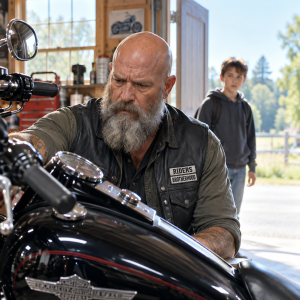
Walter Hayes had driven down from Albany after finishing an engineering conference. He was a reserved man who wore old sweaters, drove a six-year-old station wagon, and rarely discussed money. Mason adored him because he listened carefully to every story, even the long ones about playground disagreements and imaginary creatures.
Mason ran toward him, but Dad’s smile disappeared when he saw the mark on his grandson’s face.
“What happened?”
Mason lowered his eyes.
I answered before he had to.
Inside the house, Blake was laughing with Tyler over the new tablet. Dad walked into the room without removing his coat.
“Who hit my grandson?”
Blake leaned back on the sofa.
“I disciplined my son. That’s none of your concern.”
“It became my concern the moment he became afraid to ask for a birthday cake.”
Patricia folded her arms.
“Walter, you don’t get to interfere with how Blake runs his home.”
Dad looked around the room, taking in the expensive furniture, the keys to Blake’s luxury SUV, and the framed photographs of company projects displayed like trophies.
Then he turned back to my husband.
“Tomorrow, I’m taking back everything that was never truly yours.”
Blake laughed.
“What exactly are you going to take? The house, the vehicles, and the company are all in my name.”
Dad lifted the gift he had brought for Mason and headed toward the door.
“Enjoy tonight,” he said. “It may be the last evening you mistake possession for ownership.”
What the Documents Revealed
At 9:10 the following morning, Blake called from his office, shouting that three investors had withdrawn from a planned resort development near Newport.
Twenty minutes later, he called again. Two major clients had suspended their contracts, a supplier demanded advance payment, and the bank was reviewing a credit line worth several million dollars.
“Did your father contact you?” Blake demanded.
“No.”
“Tell him to call me immediately.”
For the first time since I had known him, his voice carried no confidence.
When I reached Evergreen Commercial Group, employees were whispering in the hallways. Blake stood in his glass-walled office with his tie loosened, surrounded by formal notices and loan documents.
His finance director entered carrying a thick gray binder.
“You need to read the final section of the restructuring agreement from six years ago.”
I knew nothing about a restructuring agreement. Blake had always claimed that he had built Evergreen alone, beginning with one used mower and turning it into a regional company through determination and instinct.
The documents told a different story.
Six years earlier, Evergreen had been weeks from closing. Banks had refused additional financing, vendors were demanding payment, and several projects were failing. Then an investment firm called Northbridge Holdings supplied the company with its first large infusion of capital, guaranteed new loans, and introduced Blake to clients whose contracts kept the business afloat.
Blake flipped through the pages with unsteady hands.
“Who owns Northbridge?”
The finance director pointed to the controlling shareholder’s signature.
Walter Hayes.
My father had quietly built a family investment fund after selling several engineering patents. He had supported Blake without requesting public recognition because he wanted to preserve his son-in-law’s pride and protect me from feeling caught between two men.
The agreement included a conduct provision allowing Northbridge to withdraw its guarantees if Blake engaged in serious family misconduct, financial dishonesty, or behavior that placed the company’s reputation at risk.
“One clause can’t erase an entire company,” Blake said.
“The clause isn’t the only problem,” the finance director explained. “Our loans depend on Northbridge’s guarantees. Without them, the bank considers us a much greater risk. Clients and suppliers have reached the same conclusion.”
By the end of the week, equipment had been reclaimed, four projects had paused, and the company vehicles were scheduled for collection. Patricia came to our house in tears, though her concern had little to do with Mason.
“What will the neighbors think when they see people taking the cars?”
Allison arrived only long enough to collect Tyler’s tablet. After that, she stopped answering Blake’s calls.
One evening, Blake sat alone in the darkened living room.
“Do you think your father can fix this?”
He still did not ask how Mason was feeling. He asked about the company.
The next morning, he drove to my father’s modest lake house near Saratoga Springs. I followed separately and found Blake kneeling on the porch.
“Give me another chance,” he pleaded. “I’ll become a better husband and father. Restore the guarantees, and I’ll prove it.”
Dad regarded him quietly.
“Did you come here because of Mason, or because of your money?”
Blake had no answer.
Dad went inside and returned carrying a white bakery box. Blake reached for it as though it might contain a contract that would restore everything.
When he opened the lid, he found a small chocolate cake and seven blue candles.
The Question Blake Could Not Escape

Dad set the cake on the table between them.
“This was all your son asked of you,” he said. “Not a vehicle, a vacation, or an expensive device. He wanted to sit beside his parents, hear that they were glad he had been born, and blow out seven candles. Why was that too much?”
Blake looked down at the cake.
Dad placed a brown envelope beside it.
Inside was a copy of a drawing Mason had made after his birthday. It showed a small boy beside a cake, a woman holding his hand, and an empty space where his father should have stood.
Behind the drawing was an old hospital photograph of Blake holding newborn Mason. On the back, in Blake’s handwriting, were the words, “You will always have my love.”
Blake read the sentence again and again.
“I don’t remember writing this.”
“That’s the problem,” Dad replied. “You forgot who you were before success became more important than kindness.”
Blake covered his face.
“I failed him.”
“You did not fail when you lost your contracts. You failed when your son decided it was safer to stop asking for love.”
Blake lowered himself to his knees again.
“I can change. Restore the company, and I’ll make everything right.”
Dad shook his head.
“You’re still confusing two separate matters. Your relationship with Mason has nothing to do with your balance sheet. A child’s trust cannot be purchased by rescuing a business.”
Northbridge would not restore the guarantees, but Dad had no intention of abandoning hundreds of innocent employees. His fund would purchase Evergreen’s viable projects and transfer them to a different management company. Employees would keep their jobs and benefits, while Blake would lose the company name, its assets, and his authority. He would remain responsible for his personal obligations.
“I’m not pushing your employees down with you,” Dad said. “I’m giving them a chance to stand without you.”
On the drive home, Blake held the cake box against his chest. He did not mention money once.
Mason was building a wooden racetrack in the living room when we returned. He stood cautiously when he saw his father but did not run toward him as he once had.
Blake placed the cake on the table and knelt several feet away.
“Mason, what I did on your birthday was wrong. You weren’t spoiled, and you weren’t asking for too much. I was cruel, and none of it was your fault.”
Mason looked at me before answering.
“Are you sorry because Grandpa took your company?”
The question landed with painful precision.
“I’m sorry because I made you afraid of me,” Blake said.
“When I remember it, I still hurt here.”
Mason touched his chest rather than his cheek.
Blake closed his eyes.
“Will you forgive me?”
“Mom says forgiving someone doesn’t mean everything goes back to how it was.”
“She’s right. I’ll give you whatever time you need.”
Mason glanced at the bakery box.
“Is that my cake?”
“Yes.”
“It’s late.”
Blake managed a small, sorrowful smile.
“It is. That’s my fault too.”
Mason did not want to light the candles. He said he would rather wait until Grandpa could be there, and Blake accepted his decision without arguing.
It was the first small sign that he might finally be learning that love required patience rather than control.
Seven Candles, Three Months Late

Evergreen disappeared quickly after that. The bank collected the vehicles, and our heavily mortgaged house was placed on the market. Blake’s vacation property and two sports cars were sold to cover his personal obligations.
Patricia accused my father of humiliating the family.
“A decent family doesn’t take away a father’s livelihood,” she said.
“A decent family doesn’t applaud when a frightened child is treated that way,” I answered.
I filed for divorce, not because Blake had lost his company, but because years of financial control and intimidation had taught me that our home had never been as secure as it appeared.
When Blake received the papers, he looked tired rather than surprised.
“Is there any chance we can try again?”
“Not if trying again means Mason and I must forget everything so you can feel forgiven.”
“I’m changing.”
“Then change because it’s right, not because you expect your old life to be returned.”
Blake agreed to the terms. I received primary custody, while his early visits with Mason would be supervised. He rented a small apartment and found work as a project estimator for another company. There was no private office or assistant, but over time he began to understand that ordinary work was not a punishment.
He also started counseling. At first, he spent each session explaining the pressures he had faced as a business owner until the counselor interrupted him.
“Mason isn’t visiting to hear why you were stressed,” she said. “He is watching to learn whether he is safe with you.”
Blake slowly stopped offering excuses. He learned not to demand hugs, raise his voice, or arrive with extravagant presents. One Saturday, he brought a simple soccer ball.
“This is for you,” he told Mason. “But you don’t have to play with me unless you want to.”
They kicked it around the yard for twenty minutes without saying much. When it was time for Blake to leave, Mason did not hug him, but he called after him.
“You can come back next Saturday.”
Meanwhile, I bought a secondhand commercial sewing machine and opened a small alterations shop called Second Stitch. I began with school uniforms and bridesmaid dresses, and within several months, I hired two women who were also rebuilding their independence.
We were not wealthy, but every dollar came from honest work, and no one stood over me examining receipts.
Three months after Mason’s birthday, Dad invited us to his lake house. A navy-blue bicycle waited in the yard beside a properly fitted helmet, and beneath the maple trees stood a fresh chocolate cake with seven candles.
Blake had also been invited. He arrived in a plain button-down shirt carrying a small wrapped book. He remained near the gate, making no assumption that he would be included.
Mason studied him for several seconds.
“Are you staying?”
“Only if you want me to.”
Mason looked at Dad and then at me.
“He can stay, but I want him to light the candles.”
Blake approached the table and lit them one at a time. His hands trembled slightly, but he did not reach for Mason.
“Make a wish,” I said.
Mason closed his eyes and blew with all his strength. Two candles remained lit, making everyone laugh. Blake leaned forward to help, then stopped himself.
“May I?”
Mason nodded.
Father and son blew together until the final flames disappeared.
That moment did not erase what had happened, and no one pretended it did. Yet it was the first time Blake had asked permission before entering his son’s space, and sometimes genuine change begins with something that small.
Later, Blake handed me the plastic spoon Mason had been holding on his birthday.
“I found it before the house was sold,” he said. “I kept it so I would remember the moment I lost everything.”
“Don’t keep it to punish yourself,” I told him. “Keep it as a reminder never to make someone who depends on you feel small again.”
As the afternoon softened, Mason climbed onto his new bicycle. Dad ran behind him until he found his balance. Blake started forward, then waited.
Only when Mason called, “Dad, look at me!” did Blake begin to run.
I watched them without confusing hope with forgetfulness. Blake would need years of consistent choices to rebuild what he had damaged. Mason would decide how much trust to offer, and no adult would hurry him.
Dad stood beside me, watching Mason pedal across the lawn.
“Money didn’t create this family’s problems,” he said. “It simply revealed them.”
He was right. When the privileges disappeared, Patricia and Allison disappeared with them. When Blake’s authority vanished, he was finally forced to face himself. And when fear no longer governed our home, Mason and I discovered that we could build something quieter and stronger.
That evening, Mason fell asleep in the car with his bicycle helmet resting in his lap and a slice of cake packed beside him.
Just before closing his eyes, he whispered, “Mom, next year I want a birthday again.”
I reached back and squeezed his hand.
“You’ll have one every year, even if it’s only a little cake and the people who truly love you.”
He smiled.
“That’s enough.”
Justice was never really about watching Blake lose his company. It was about watching my son recover the courage to want something without feeling ashamed.
Blake had once believed that anything carrying his name belonged to him. In time, he learned that trust, respect, and affection can never be owned. They must be cared for, patiently and humbly, every day.
And Mason—the little boy who once promised never to ask for anything again—taught all of us the lesson his father had forgotten: a child may eventually choose to forgive, but no child should have to learn fear before being shown love.