The Invitation Lenore Meant as an Insult

Benjamin Ashford had been raised to believe that a family name could be more important than the people carrying it. The Ashfords owned coastal resorts, marinas, and historic properties throughout Rhode Island, and his mother, Lenore, guarded their reputation with the devotion other people reserved for faith.
That was why she never accepted Mara Ellis.
Mara came from a small Massachusetts town, where her father worked as an electrician and her mother kept accounts for a hardware store. She studied communication therapy, worked evenings helping adults prepare for job interviews, and dreamed of opening a community center for people who had been overlooked by schools and employers.
Benjamin met her beside a broken printer in the university library. His papers had scattered across the floor, and Mara crouched to help him gather them.
“You can glare at that machine all night, but I don’t think it feels guilty.”
He laughed, and from that afternoon forward, life around her felt easier.
With Mara, he was not an heir or a future chairman. He was simply a young man who liked long drives, burnt toast, and quiet Sunday mornings. He spoke of a small house near the water and children running through the hallway.
Then he brought her home.
Lenore received Mara with polished courtesy, but at dinner she said, “Kindness is admirable, but a family like ours must think about continuity.”
Mara understood the warning. Benjamin chose not to.
Months later, Lenore insisted on medical testing before any engagement. The doctor explained that Benjamin might have difficulty becoming a father and that Mara had a condition that could complicate pregnancy, though neither result made parenthood impossible.
Lenore turned uncertainty into judgment.
“Marriage is not only about affection. It is about what two people can responsibly build.”
Mara waited for Benjamin to defend her.
He lowered his eyes.
That silence ended their future more completely than any argument could have.
Mara left the Ashford estate with one suitcase. Benjamin did not follow.
Eight weeks later, an ultrasound showed three tiny flickers.
Triplets.
Mara called Benjamin until his number stopped working. She mailed letters to his apartment, office, and family home. Every envelope returned unopened or marked refused. On her final call, Lenore answered.
“Benjamin has made his choice. Do not contact him again.”
Mara tried to explain the pregnancy.
After a pause, Lenore replied, “Whatever you are about to claim will not alter his future.”
Then the call ended.
Seven Years of Building a Different Life
Seven years later, Mara lived in a cedar house outside Camden, Maine. The porch needed paint, the upstairs faucet whistled, and the kitchen floor leaned slightly toward the pantry, but it was the first place that truly belonged to her.
More importantly, it was home to Tessa, Cole, and Maisie.
Tessa, the eldest by three minutes, loved books and difficult questions. Cole dismantled clocks and toys because he needed to know how everything worked. Maisie collected sea glass and believed cinnamon toast could improve almost any day.
They knew their father did not live with them. Mara had always answered carefully.
“Did he love you?” Tessa once asked.
“I believe he did, once.”
“Does he know about us?” Cole asked.
“I tried to tell him.”
The early years had been exhausting. Mara tutored in church rooms, worked weekend shifts at a rehabilitation clinic, and prepared lessons after midnight while three bassinets stood beside her bed. Her parents helped when they could, but she learned to stretch groceries, sleep in fragments, and keep moving even when she felt emptied out.
Eventually, a county grant helped her open Harbor Steps, a community center offering workplace communication, computer training, English classes, and test preparation. It began in a vacant insurance office with eight folding chairs. By its fifth year, more than a hundred people passed through its doors each month.
Mara had built a life no family fortune could measure.
Then, on a rainy April afternoon, a cream envelope appeared on her desk.
Her office manager, Denise, looked at the heavy paper and said, “That invitation seems expensive enough to have its own attorney.”
Mara almost smiled until she recognized the handwriting.
Inside was an invitation to Benjamin Ashford’s wedding to Katherine Winslow at the Ashford Harbor Hotel in Newport. Behind it was a handwritten note.
I thought you should witness the life Benjamin was wise enough to choose. Perhaps it will help you understand where you always belonged.
L.A.
For a moment, Mara felt twenty-four again, standing in the Ashford foyer while Benjamin remained behind his mother. Then the old shame gave way to clarity.
Lenore wanted an audience. She wanted Mara to enter a ballroom filled with wealthy guests, watch Benjamin marry an approved woman, and accept that she had been replaced.
Mara carried the invitation home.
Tessa found it near the sink after dinner.
“Who is Benjamin Ashford?”
Mara dried her hands.
“Someone I knew before you were born.”
Tessa studied her face. “Is he our father?”
Cole stopped drinking his milk. Maisie lowered the green bean she had been slipping to the dog.
Mara sat beside them.
“Yes.”
“Does he know about us?” Cole asked.
“I wrote. I called. Nothing came back except the letters.”
Maisie’s eyes filled. “Maybe he didn’t want us.”
Mara took her hands.
“Whatever happened between the adults had nothing to do with your worth. I loved you from the first moment I knew you were there.”
That night, Mara opened a wooden box containing hospital bracelets, tiny knitted caps, and more than twenty returned envelopes. She placed Lenore’s wedding note beside them.
The capital R had the same slant. The F in refused carried the same sharp hook.
Perhaps Benjamin had ignored her.
Or perhaps he had never known.
At sunrise, Mara called the wedding coordinator.
“This is Mara Ellis. I’m confirming my attendance.”
“Will you be bringing a guest?”
Mara looked toward the children’s rooms.
“Three. My children.”
The Question That Stopped the Ceremony

The Ashford Harbor Hotel overlooked Narragansett Bay, its white stone entrance framed by flowers and polished brass. Luxury cars curved along the drive while photographers waited near the doors.
Mara nearly turned around.
Then Tessa touched her shoulder from the back seat.
“Mom, we came this far.”
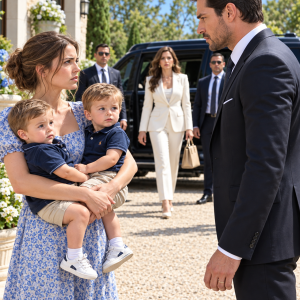
Tessa wore a gold dress, Cole a navy suit, and Maisie a pale blue ribbon in her hair. They looked nervous, but they also looked unmistakably like Benjamin: the same gray-green eyes, thoughtful head tilt, and crooked left eyebrow.
Inside, white roses climbed tall arches beneath crystal chandeliers. Benjamin stood near the front in a black tuxedo, speaking to his best man.
Mara saw him first.
He looked older and more guarded, but she could still remember the young man laughing beside a broken printer.
Then he turned.
His gaze found Mara, moved to the children, and stopped. The change in his face was so complete that his best man reached for his arm.